
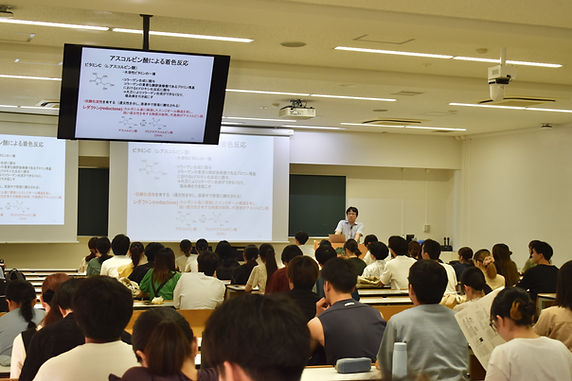
Lectures in Department of Applied Biosciences
Organic Chemistry
Plant Sciences
-
Organic Chemistry 1~4 (1st year ~ 3rd year)
-
Bioactive Natural Product Chemistry (3rd year) etc.
Course Content: This course broadly covers the properties, synthesis methods, reactivity, and reaction mechanisms of fundamental functional groups in organic compounds. Students will also learn about the chemical structures, biosynthesis, and mechanisms of action of natural organic compounds (bioactive substances) that play crucial roles in biological phenomena, as well as their applications in pesticides and pharmaceuticals.
Keywords: Organic Chemistry, Bioactive Natural Products, Pharmaceuticals
VOICE
Comments from enrolled students
Back in high school, organic chemistry was quite a memorization challenge, but here, you'll get to explore its many reactions in a fun, logical, and systematic way. You'll enjoy developing skills to analyze different spectra and even designing and synthesizing molecules on your own. It's truly exciting to see how living organisms use these chemical reactions and how new pharmaceuticals and pesticides are created from natural organic compounds.
-
Plant Physiology (2nd year)
-
Plant Functional Biology (3rd year) etc.
Course Content: This course comprehensively addresses biology, with a specific emphasis on botany. Our objective is to elucidate plant cell biochemical processes, including photosynthesis, developmental patterns, and adaptive responses to environmental changes. The course examines these phenomena starting from the molecular level, involving genes and proteins.
Keywords: Photosynthesis, Plant Development, Plant Environmental Responses
VOICE
Comments from enrolled students
High school biology introduces you to fascinating topics like photosynthesis and plant development. When you move on to university, you get the chance to explore these subjects on a deeper, molecular level, which makes the learning experience even more exciting. These classes really sparked my passion for plants and biology, inspiring me to join a research lab dedicated to plant studies.
Biochemistry and Cell Biology
Food Sciences
-
Biochemistry 1~3 (1st–2nd year)
-
Molecular and Cellular Biology 1–4 (1st–3rd year) etc.
Course Content: This course encompasses the mechanism by which genes, which serve as carriers of biological information, are translated into proteins via mRNA, as well as the diverse functions of proteins. Additionally, we will examine the reactions of enzymes that govern metabolic processes, with the goal of understanding life at the molecular level.
Keywords: Genes, Proteins, Enzyme Reactions
VOICE
Comments from enrolled students
When I studied how genes and proteins are regulated, I gained a deeper understanding of what goes on inside cells, which are so tiny we can't see them without help. It made me appreciate just how beautifully complex and carefully built the systems in living creatures are, and I found that incredibly exciting.
-
Food Functional Chemistry (3rd Year)
-
Food Hygiene (4th Year) etc.
Course Content: The course involves examining the properties and functionality of food components at the molecular level. Participants will explore various chemical reactions that occur within food. Additionally, the curriculum covers food poisoning agents and their mechanisms of toxicity. This course is a prerequisite for obtaining qualifications such as Food Sanitation Manager, which is offered by the Department of Applied Life Sciences.
Keywords: Food functionality, nutrients, food safety and security
VOICE
Comments from enrolled students
Ever wondered why delicious foods turn brown? We also explore how the components from the foods we enjoy work inside our bodies. I realized that even though food is something we see and use every day, there's a lot about it that still surprises us. That curiosity is what inspired me to join a food science research lab.
Microbiology
Data Sciences
-
Microbiology II (3rd year)
-
Microbial Physiology (3rd year)
-
Bioreaction Engineering (3rd year) etc.
Course Content: Acquire a broad range of specialized knowledge concerning microorganisms, including the distribution and roles of various microorganisms inhabiting the environment, as well as their utilization in industry and reaction processes.
Keywords: Industrial Microorganisms, Fermentation, Environment
VOICE
Comments from enrolled students
Learning about how microorganisms are used in industry, like enzymes and fermentation, was truly fascinating. I also enjoyed discovering their history and seeing real-world examples. Plus, I gained a better understanding of how these tiny, often unnoticed creatures influence ecosystems all around us. It really deepened my curiosity about these amazing, mysterious beings.
-
Bioinformatics practicum (2nd year)
-
Student experiments (3rd year), etc.
Course Content: Learn practical methodologies for analyzing data acquired from experiments and databases utilizing various analytical tools and programming languages.
Keywords: Bioinformatics, Programming, Structure Prediction, etc.
VOICE
Comments from enrolled students
From fundamental statistics to a variety of database usage methods, you can explore analytical techniques commonly employed in experiments in a structured way. I genuinely believe that this knowledge of statistics and your analytical skills will become valuable assets, helping you both during your student years and beyond into your career.
Mini-Lecture by the Faculty of
Applied Biosciences
On Yume Navi, you'll have the chance to enjoy "mini lectures" by our department's faculty members, which can help you explore academic fields that truly spark your curiosity.
Just click through using the Yume Navi banner to start your journey!
